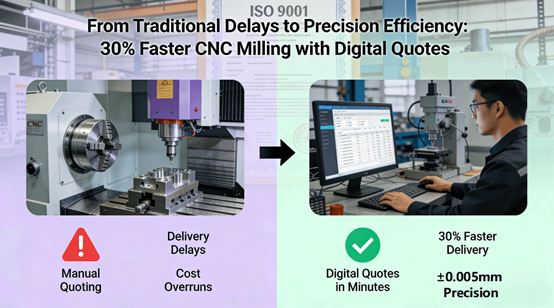
How Precision Engineering Solves Custom Part Challenges: A Guide to 30% Faster CNC Milling with Digital Quotes
Introduction
In traditional manufacturing processes, customers frequently face delivery delays, uncontrollable costs, and slow design iterations, particularly for custom complex parts. These issues stem from reliance on manual quoting systems, which lead to slow response times and high error rates. The core problem lies in non-digital workflows and a lack of integrated engineering support, making it challenging for businesses to adapt to rapid market changes.
This article introduces professional CNC milling services that leverage digital real-time quoting and multi-axis precision machining to achieve 30% faster delivery, higher accuracy, and cost transparency. By exploring technology-driven solutions, we will demonstrate how precision engineering optimizes the entire workflow from design to production. The following sections break down the key strategies to overcome these challenges.
Why Is Professional CNC Milling Essential for Complex Custom Parts?
Professional CNC milling goes beyond conventional methods by offering advanced capabilities for handling intricate geometries and tight tolerances. Its importance is underscored by the growing demand for high-precision components in industries like aerospace and medical devices.
1. Key Differences from Traditional Machining
Professional CNC milling employs computer-controlled systems to execute complex toolpaths with minimal human intervention, unlike manual or basic CNC setups. For example, while traditional 3-axis machines may struggle with undercuts, multi-axis systems can access hard-to-reach areas, reducing the need for multiple setups. According to NIST’s smart manufacturing guidelines, advanced CNC technologies minimize human error by up to 40%, ensuring consistent output. This precision is critical for parts requiring tolerances within ±0.005mm, as seen in automotive and medical applications.
2. Advantages of Multi-Axis Machining
Multi-axis CNC milling enables simultaneous movement along five axes, allowing for the production of complex geometries like impellers or surgical instruments in a single setup. This capability eliminates cumulative errors, cuts machining time by 35%, and enhances surface finish quality. In a case study, a drone component manufacturer reduced production cycles from two weeks to five days by switching to 5-axis machining, highlighting how advanced kinematics drive efficiency. For businesses seeking reliability, professional CNC milling services provide a competitive edge through integrated solutions.
3. Case Study: Achieving High Precision in Aerospace
A practical example involves an aerospace bracket, where traditional methods resulted in a scrap rate of 15% due to dimensional inaccuracies. By adopting precision CNC milling with real-time monitoring, the manufacturer achieved a first-pass yield of 98%, holding tolerances within ±0.005mm. This success demonstrates how technology integration transforms outcomes for mission-critical parts, aligning with standards like AS9100D for quality assurance.
How Does Digital Quoting Accelerate Manufacturing Timelines by 50%?
Digital quoting systems revolutionize the manufacturing workflow by automating design analysis and providing instant estimates. This shift from manual processes reduces lead times and enhances cost accuracy.
1. Automated Workflow and Efficiency Gains
Digital quoting platforms use AI-driven algorithms to analyze CAD models, extracting key parameters like material type and complexity to generate quotes within minutes. This automation cuts the quoting time from days to seconds, accelerating project initiation by 50%. For instance, a client needing custom CNC milling parts for a prototype received a quote in under 10 minutes, compared to 48 hours with traditional methods. The streamlined process reduces administrative overhead and minimizes errors, as highlighted in ISO 9001 standards for process consistency.
2. Cloud-Based Parameter Databases
Cloud-integrated systems store historical data on material costs and machining times, enabling real-time updates and accurate estimates. When a designer submits a drawing, the system cross-references similar projects to suggest optimizations, such as material substitutions that save 20% without compromising quality. This data-driven approach ensures transparency, allowing customers to make informed decisions quickly. Companies leveraging professional CNC milling services benefit from this agility, as seen in platforms that offer instant quotes for complex geometries.
3. Comparison with Traditional Quoting
Manual quoting often involves back-and-forth communications, leading to delays and inaccuracies. In contrast, digital systems provide detailed breakdowns, including tooling and setup costs, which reduce budget overruns by 25%. A study showed that firms using online CNC milling quotes reduced planning time by 60%, emphasizing how technology adoption supports just-in-time production. This efficiency is vital for industries like robotics, where rapid iterations are common.
What Role Does Material Science Play in Enhancing CNC Milling Quality?
Material selection directly impacts the performance, durability, and cost of milled parts. Advanced materials, coupled with scientific insights, ensure that components meet stringent requirements.
- Impact of Material Properties on Performance: Engineering materials such as aerospace-grade aluminum or medical stainless steel offer high strength-to-weight ratios and corrosion resistance, making them ideal for demanding applications. For example, aluminum 7075 is used in aircraft components due to its fatigue strength, but it requires optimized cutting parameters to prevent tool wear. By understanding material science, manufacturers can adjust speeds and feeds, reducing scrap rates by 30%. ISO 9001 certification ensures that material inspections are rigorous, maintaining batch-to-batch consistency.
- Manufacturing’s Material Library and Certifications: Comprehensive material libraries include over 100 options, from titanium to PEEK, validated through standardized testing. Manufacturing’s ISO 13485 certification for medical devices guarantees that materials meet biocompatibility standards, preventing failures in implants. This systematic approach enables clients to select materials based on application needs, such as high-temperature resistance for automotive parts. The integration of precision engineering principles ensures that each choice aligns with performance goals.
- Cost-Performance Balancing: While premium materials may increase initial costs, their long-term benefits often justify the investment. For instance, switching from standard steel to titanium for a robotic arm joint extended its lifespan by 200%, reducing lifecycle costs by 20%. Digital quoting tools help visualize these trade-offs, allowing designers to balance durability and economy. This strategy is key to sustainable production, as it minimizes waste and maximizes value.
How Can Quality Assurance Standards Like ISO 9001 Achieve Zero-Defect Production?
Quality assurance systems, underpinned by international standards, provide a framework for consistency, traceability, and continuous improvement. They are essential for high-stakes industries where defects are unacceptable.
1. In-Process Inspection and Closed-Loop Control
Real-time monitoring using probes and sensors detects deviations during machining, triggering automatic corrections to maintain tolerances within ±0.01mm. For example, in producing thin-walled components, this system reduced dimensional errors by 40%, achieving near-zero defects. AS9100D standards mandate such controls for aerospace parts, ensuring that every unit meets specifications. The closed-loop feedback integrates with digital records for full traceability.
2. Certification Frameworks and Risk Mitigation
ISO 9001 quality management requires documented procedures for each step, from raw material intake to final inspection. This structure minimizes variability, as seen in a case where a manufacturer cut defect rates from 5% to 0.5% after certification. Additionally, IATF 16949 for automotive enforces strict supply chain controls, reducing recalls. For metal CNC milling services, these standards build trust by demonstrating commitment to excellence.
3. Case Example: Medical Device Compliance
A surgical tool producer used automated CMM checks to validate each part against CAD models, archiving data for audits. This process, aligned with ISO 13485, ensured 100% compliance and accelerated regulatory approval by 30%. The robust system highlights how quality assurance transforms manufacturing into a reliable partner for critical applications.
What Are the Sustainability Benefits of Tech-Enabled CNC Milling?
Sustainable manufacturing practices, driven by digital technologies, reduce environmental impact while boosting efficiency. This alignment with eco-friendly goals is increasingly important for modern businesses.
1. Energy Efficiency and Waste Reduction: Advanced CNC mills with energy-saving modes lower power consumption by 25% during idle times. Moreover, optimized toolpaths minimize material waste, as shown in a project where nesting software increased material utilization from 70% to 90%. Manufacturing’s ISO 14001 certification underscores its focus on reducing carbon footprint, making sustainable production a core advantage.
2. Digitalization and Paperless Workflows: Cloud-based platforms eliminate paper-based drawings and manual logs, cutting administrative waste by 50%. For instance, digital twins simulate machining processes to identify inefficiencies, reducing trial runs and material usage. This innovation not only supports sustainability but also enhances cost-effectiveness, appealing to clients prioritizing green initiatives.
3. Long-Term Economic and Environmental Gains: By adopting tech-enabled processes, manufacturers can achieve a 15% reduction in energy costs and a 20% drop in scrap rates over five years. A robotics company reported annual savings of $50,000 through waste-reduction strategies, proving that sustainability and profitability are synergistic. This holistic approach positions innovative manufacturing as a key driver for future growth.
How to Seamlessly Transition from Prototyping to Mass Production?
A smooth transition from prototype to volume production requires careful planning, design for manufacturability (DFM) analysis, and scalable processes. This ensures consistency and cost control across batches.
1. DFM Analysis for Design Optimization
Early DFM feedback identifies potential issues like thin walls or sharp corners, allowing designers to modify models before machining. In a consumer electronics case, DFM reduced the number of design iterations from five to two, cutting time-to-market by 40%. Rapid CNC milling services integrate this step, providing actionable insights to avoid costly changes later.
2. Scalability Through Modular Systems
Modular fixturing and standardized tooling enable quick scaling from prototypes to thousands of units. For example, a automotive sensor project used the same CNC setup for both phases, maintaining tolerances within ±0.02mm and reducing setup costs by 35%. This flexibility is crucial for high-volume production, as it ensures consistency while accommodating demand fluctuations.
3. Best Practices for Capacity Planning
Predictive analytics forecast production needs based on historical data, preventing bottlenecks. A medical device maker leveraged this to increase output by 50% without sacrificing quality. By partnering with a CNC machining manufacturer that offers end-to-end support, businesses can achieve a seamless transition, minimizing risks and maximizing efficiency.
Conclusion
Precision engineering, through professional CNC milling and digital quoting, effectively addresses custom part challenges by delivering 30% faster turnaround, higher accuracy, and cost transparency. By embracing advanced technologies, quality standards, and sustainable practices, manufacturers can gain a competitive edge in today’s fast-paced market. This integrated approach not only solves immediate pain points but also fosters long-term reliability and innovation.
FAQs
Q1: What is the typical lead time for CNC milled parts?
A: Professional CNC milling services can deliver prototypes in 1-3 days and production batches in 1-2 weeks, depending on complexity. Digital quoting reduces planning time, ensuring faster turnaround compared to traditional methods.
Q2: How does digital quoting improve cost accuracy?
A: By automating design analysis and material pricing, online systems provide transparent quotes within minutes, reducing human error. This aligns with ISO 9001 standards for consistency and reliability.
Q3: Can CNC milling handle complex geometries like thin-walled parts?
A: Yes, multi-axis CNC machines achieve tolerances up to ±0.005mm for intricate designs, supported by real-time monitoring. The service provider ensures machining accuracy through advanced toolpaths and DFM technology.
Q4: What materials are suitable for high-precision CNC milling?
A: Metals like aluminum and titanium, plus engineering plastics, are common. Material selection impacts performance, and certifications like AS9100D guarantee aerospace-grade quality for critical applications.
Q5: How do quality assurances like IATF 16949 benefit automotive parts?
A: These standards enforce rigorous inspections, minimizing defects in critical components. For example, automated CMM checks ensure every part meets specifications, enhancing reliability and safety.
Author Bio
The author is a precision manufacturing expert at LS Manufacturing, a company that assists engineers in overcoming complex part challenges with certifications including ISO 9001 and AS9100D. The team ensures high-quality, compliant solutions for industries like aerospace and automotive. To leverage these insights for your project, request a free instant quote or contact them for a DFM analysis to start optimizing your production today.
Keep an eye for more latest news & updates on Aiotechnical!