The “Impossible” Geometry: A Deep Dive into Soluble Supports
Every 3D printing enthusiast learns the “45-Degree Rule” on day one. It is the fundamental law of Fused Deposition Modeling (FDM): you cannot print in thin air. If a part of your model hangs over empty space without anything underneath it, gravity wins, and the plastic droops into spaghetti.
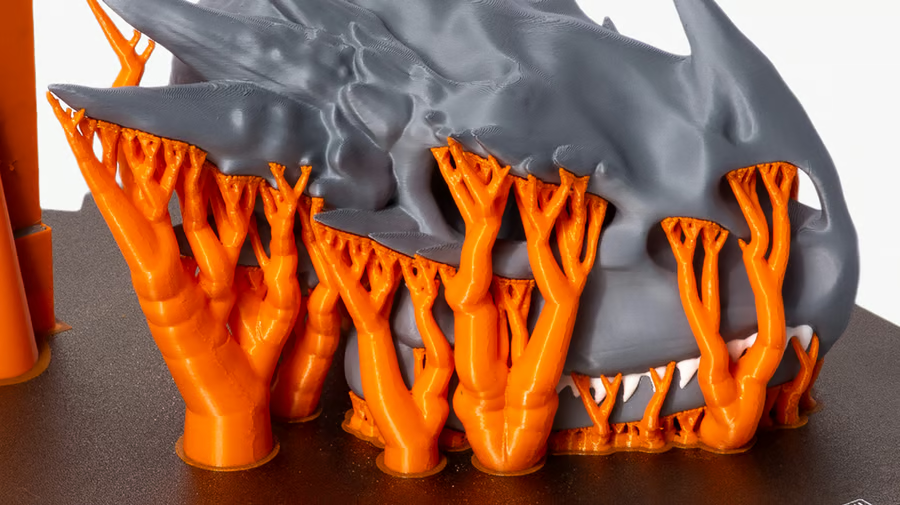
To fight gravity, we use supports—scaffolding structures printed alongside the model. For 90% of prints, standard “breakaway” supports work fine. You print the support, the model prints on top of it, and when you are done, you snap the scaffolding off with pliers.
But what happens when you can’t reach the support with pliers?
Imagine printing a hollow sphere with a smaller sphere floating inside it. Or a complex hydraulic manifold with internal twisting channels. If you fill those internal voids with standard supports, you seal them shut forever. You cannot reach inside to break the material away. These are “impossible geometries.”
The solution to this paradox is not mechanical; it is chemical. By utilizing water-soluble materials like PVA (Polyvinyl Alcohol), we can print solid supports that vanish in a bucket of tap water. This capability, enabled by advanced multi-material hardware, is the final frontier of desktop fabrication.
The Magic of PVA
PVA is a fascinating polymer. It is the same material used in dishwasher detergent pods. It is rigid and printable like PLA, but it is highly hygroscopic—it loves water.
When you print a complex interface using PVA, you don’t have to worry about “tool clearance” for your pliers. You can fill an entire internal cavity with dense PVA support. Once the print is finished, you submerge the object in warm water. Over the course of a few hours, the PVA turns into a slimy gel and dissolves completely, leaving the Model material (PLA or PETG) perfectly intact.
This unlocks “Design for Additive Manufacturing” (DfAM) in its purest form. Engineers can design gyroid heat exchangers, pre-assembled gearboxes, and organic lattices without worrying about how to remove the scaffolding.
Why Hardware Architecture Matters
Here is the catch: PVA is notoriously difficult to print. It is expensive, it absorbs moisture from the air instantly, and most importantly, it degrades rapidly if kept hot for too long.
This is where the architecture of your 3d printer becomes the deciding factor.
On single-nozzle multi-material systems (AMS style), printing PVA is a nightmare. The machine has to heat the nozzle to print the PLA model, then purge, then load the PVA. While the PVA is sitting in the hot nozzle during the PLA printing phase, it “cooks” and carbonizes, leading to inevitable jams. Furthermore, sharing a nozzle means you often get bits of PLA mixed into your soluble interface, creating a bond that won’t dissolve.
The superior solution is a Tool Changer or IDEX (Independent Dual Extruder) system. A machine like the Snapmaker U1 allows you to keep a dedicated “PVA Toolhead.” This toolhead only heats up when it is needed. It never gets contaminated with PLA. It prints the interface and parks itself.
Beyond Color: The Multi-Material Powerhouse
While often marketed primarily as a color 3d printer, machines with independent toolheads are actually “Multi-Material Manufacturing Centers.” The ability to switch colors is just the flashy side of the coin; the functional side is the ability to switch chemistries.
The combination of PLA (for the model) and PVA (for the support) is the most common pairing, but it is not the only one.
- HIPS and ABS: For high-temperature industrial prints, engineers use HIPS (High Impact Polystyrene) as a support material for ABS. HIPS dissolves in Limonene, a citrus-based solvent.
- Breakaway Interfaces: Even without soluble materials, a tool changer allows you to print a PETG model with PLA supports. Because PETG and PLA do not bond chemically, the supports pop off with zero effort, leaving a glass-smooth surface that requires no sanding.
The Cost of Freedom
Printing with soluble supports does add cost and time. PVA is significantly more expensive than standard PLA, and swapping materials adds to the print duration.
However, the trade-off is often “time vs. impossibility.” If you need a functional prototype of a complex valve assembly, the alternative to 3D printing with soluble supports is often 5-axis CNC machining, which costs thousands of dollars and takes weeks. In that context, a 20-hour print with $5 worth of soluble support material is a bargain.
Conclusion: Complexity is Free
There is an old saying in manufacturing: “Complexity is free.” In traditional machining, drilling one hole is cheap; drilling ten holes costs ten times as much. In 3D printing, the machine doesn’t care how complex the shape is; it only cares about the volume of plastic.
Soluble supports allow us to fully realize this promise. They remove the geometric handcuffs of gravity. Whether you are an architect printing a delicate lattice structure or an engineer prototyping a hollow air duct, the ability to dissolve the scaffolding allows you to design for the function of the part, not the limitations of the machine.
Keep an eye for more latest news & updates on Aiotechnical!