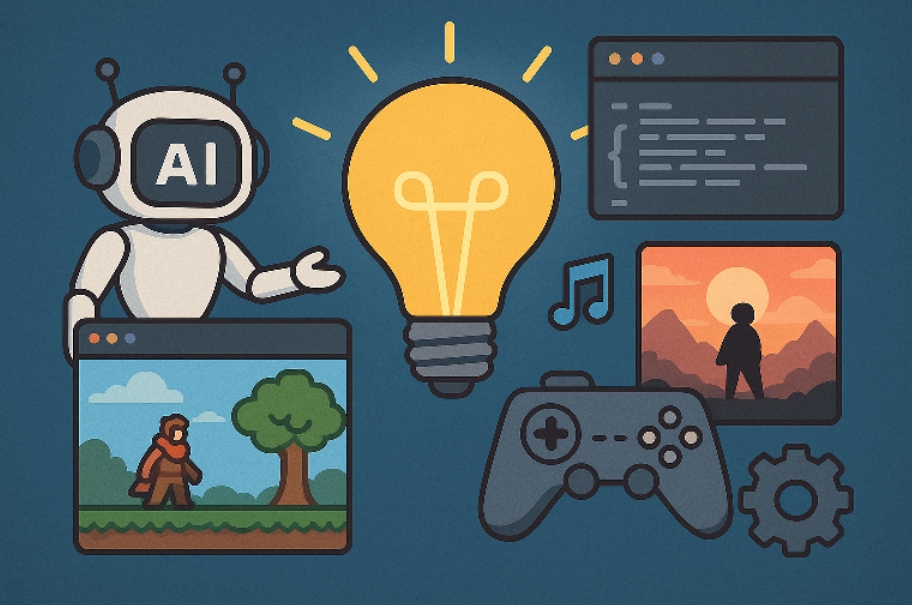
AI Game Builders: The Future of Prompt-Based Game Creation
Imagine describing a game idea in a few sentences and watching it spring to life on your screen. What sounds like science fiction is rapidly becoming a reality. The next frontier in game development isn’t about mastering complex code or intricate software; it’s about mastering language. The rise of the AI game builder is putting the power of creation into the hands of anyone with an idea, using simple text prompts to build entire worlds.
This new wave of technology, known as prompt-based game creation, is set to fundamentally change who can make games and how they are made. It tears down the technical barriers that have long defined the industry, making development more intuitive, faster, and radically more accessible.
This article will explore how these intelligent tools work, the incredible benefits they offer, and how platforms like Astrocade are showcasing games like Snake Path Puzzle and Aether Isle that embody this new, creative spirit.
What is an AI Game Builder?
An AI game builder is a platform that uses advanced artificial intelligence, particularly large language models (LLMs) and generative AI, to interpret natural language commands and convert them into functional game elements. Instead of writing code or using a drag-and-drop interface, you simply tell the AI what you want.
This process is often called “prompt-based game building.” A prompt can be a simple instruction or a detailed description to create games like Capybara Clicker and Potion Commotion.
For example, a prompt could be:
- “Create a 2D side-scrolling level with a forest theme and floating platforms.”
- “Generate a player character that looks like a robot knight with a laser sword.”
- “Make an enemy that patrols back and forth and shoots projectiles if it sees the player.”
The AI parses this text, understands the intent, and generates the corresponding assets, logic, and level layout. It’s a collaborative process where the developer acts as a director, guiding the AI to bring their vision to life.
How Prompt-Based Creation is Revolutionizing Development
This new method isn’t just a gimmick; it offers tangible advantages that are reshaping the development workflow from the ground up.
1. Unmatched Speed and Iteration
Traditional game development involves a slow, methodical process of prototyping. An idea for a new mechanic might take days or weeks to code and test. With an AI game builder, that same idea can be prototyped in minutes.
You can instantly test variations of your concept. What if the character could double jump? Just prompt the AI: “Give the player a double jump.” What if the enemies were faster? “Increase enemy speed by 20%.” This ability to rapidly iterate allows creators to find the “fun” in their game much faster, discarding bad ideas without losing significant time or resources.
2. Unleashing Boundless Creativity
Technical limitations often stifle creativity. A developer might have a fantastic idea for a game mechanic but lack the coding skills to implement it. Prompt-based creation removes that bottleneck. If you can describe it, you can create it.
This opens the door for more experimental and innovative game designs. Creators are no longer constrained by the pre-built templates of a traditional game engine. They can blend genres, invent new mechanics, and build worlds that were previously too complex or time-consuming to attempt as a solo developer.
3. Radical Accessibility
This is perhaps the most profound impact of the AI game builder. It democratizes game development on a massive scale. Writers, artists, musicians, and anyone with a story to tell can now become a game creator without spending years learning to code.
This influx of new voices will lead to a more diverse and interesting gaming landscape. We will see games that explore themes and ideas that major studios might overlook, created by people from all walks of life.
The Developer’s New Role: The AI Director
The rise of the AI game builder does not make developers obsolete. Instead, it changes their role. The developer of the future will be less of a coder and more of a director, curator, and visionary.
Their skills will shift from technical implementation to creative guidance. Success will depend on:
- Prompt Engineering: The ability to write clear, effective prompts that guide the AI to the desired outcome.
- Creative Curation: Sifting through AI-generated options to select the assets and mechanics that best fit the game’s vision.
- High-Level Design: Focusing on the big picture—game feel, pacing, narrative, and the overall player experience.
Conclusion
We are at the beginning of a paradigm shift in interactive entertainment. The AI game builder is transforming game creation from a rigid, technical discipline into a fluid, creative conversation between human and machine. Prompt-based creation is breaking down the last major barrier to entry, inviting a new generation of creators to the table.
Games like Snake Path Puzzle and Aether Isle are early glimpses into a future where the only prerequisite for making a game is a powerful imagination. The tools are evolving at an astonishing pace, and soon, the answer to the question, “How do I build a game?” will be simple: you just have to ask.