Concrete Driveway Repair Methods That Prevent Small Surface Cracks From Developing Into Larger Problems
A thin crack across a concrete driveway rarely looks like an emergency, so it is easy to step over it for a season, then another, until the line widens, the edges crumble, and a panel starts to sink. By then a tube of sealant will no longer do the job, and the bill has grown from a weekend project into a contractor’s quote. Most small surface cracks, though, are cheap and simple to stop if the repair matches the crack.
- In short: Seal small, stable driveway cracks early with a flexible polyurethane or silicone sealant, after cleaning the crack and fitting a backer rod in anything deeper than about half an inch. That keeps water out, flexes as the slab moves with temperature, and stops the freeze-thaw cycle that turns a hairline into a break. Wider cracks, sunken panels, and cracks that keep growing need a different fix, as this guide explains.
Reading the Crack: What Hairline Lines, Crazing, and Wider Splits Are Actually Telling You
Not every crack is the same problem, and treating them all with the same product is the most common reason repairs fail. Hairline cracks, thinner than a credit card, are usually shrinkage cracks from curing, or surface crazing, a fine web of shallow lines from rapid drying of the top layer. They look alarming in low sunlight but rarely threaten the slab; their real danger is giving water a way in.
Cracks between about one-eighth and one-quarter of an inch wide deserve more attention, especially if they run across a panel rather than following a control joint. A single straight crack unchanged for a year is often a stable shrinkage or thermal crack. A crack that widens, has one side higher than the other, or appears alongside sinking or puddling suggests the base has moved, and that distinction decides everything that follows.
Why Small Cracks Grow: Freeze-Thaw, Water, and the Base Beneath the Slab
Concrete is strong in compression but weak in tension, so it cracks when pulled apart by shrinkage, temperature change, or a shifting base. Water then does the real damage: rain and meltwater seep into the crack, freeze, and expand, levering it wider a fraction at a time, while de-icing salts accelerate scaling around the opening.
Below the surface, the same water erodes the compacted base. Downspouts discharging beside the slab, soil sloping toward the driveway, and tree roots all feed the problem differently: erosion washes fine material out from under the panel, roots lift it, and poor drainage keeps the base saturated. A repair that only fills the visible crack while the drainage problem continues is temporary.
A Driveway Crack Diagnosis Walk: Mapping Every Crack Before You Buy Anything
Spend twenty minutes walking the driveway before buying a single tube. Work panel by panel, noting each crack’s width, length, direction, and whether one side sits higher than the other. A pencil mark and a dated phone photo give you a baseline for re-checking in three months.
- Width: hairline, under one-eighth inch, one-eighth to one-quarter inch, or wider.
- Movement: level edges, or one side raised, sunken, or rocking underfoot.
- Pattern: single line, branching network, crazing, or a crack following a joint.
- Water clues: puddles, stains, moss, weeds in the crack, or downspouts discharging nearby.
Matching the Fix to the Crack: Sealant, Patch, Resurfacer, or Leaving It Alone
The repair method should match the crack’s width, movement, and depth, not the product with the best packaging. Flexible sealants suit stable cracks that still move slightly with temperature. Rigid cement-based patching suits shallow surface damage where the slab is not moving. A bonded resurfacer suits a widely worn surface on a sound base, while a sunken panel needs a contractor.
Sealing a Hairline Driveway Crack, Step by Step
Sealing is the highest-value small repair a homeowner can do, and preparation matters more than the brand of sealant. A sealant bonded to dust or moss will peel away with the first freeze, so cleaning is not optional. Work on a dry day, and keep vehicles off for the cure time on the product.
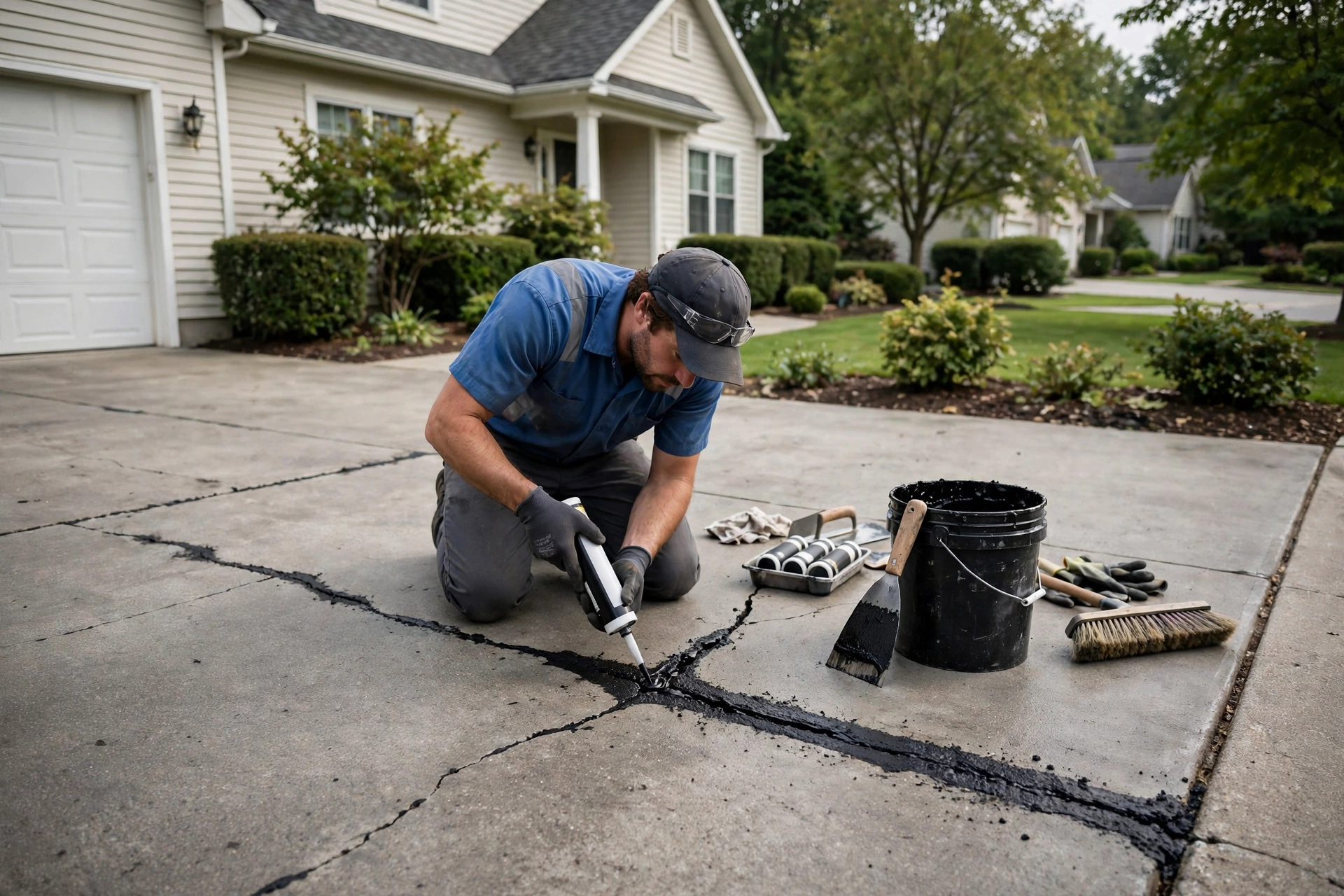
- Sweep the crack clear, scrub it with a wire brush, and blow or vacuum out loose particles.
- If the crack is deeper than about half an inch, press a foam backer rod into it.
- Mask the edges with painter’s tape, then gun the sealant in slowly, slightly overfilling.
- Tool it lightly with a putty knife so it wets both edges, then pull the tape immediately.
- Leave the repair undisturbed for the full cure time, and check it after the first heavy rain.
- Use self-leveling sealant on flat cracks and non-sag sealant on slopes.
When a Wider Crack Needs a Patch or a Resurfacer Coat
Cracks wider than about half an inch swallow tube sealant without filling, so a cement-based patching compound is the better bulk repair. Clean and dampen the area first, since a dry, dusty surface starves the patch of the moisture it needs to bond. Press the compound firmly in, shape it slightly proud of the surface, and once cured, run flexible sealant along the top edge.
When fine cracks, pitting, and flaking cover a large share of a panel, patching each one individually becomes false economy. A polymer-modified resurfacer, spread as a thin bonded layer over the prepared slab, renews the whole surface at once. It only works on a sound slab: if the panel has sunk, the new layer will crack in the same places.
The Backer Rod Trick That Keeps Flexible Sealant From Splitting
Backer rod is a cheap foam rope, and it is the most skipped step in driveway crack repair. Without it, sealant poured into a deep crack bonds to the bottom as well as the sides, so when the slab moves, the sealant is pulled in three directions and tears down the middle. With a backer rod pressed in first, the sealant bonds only to the side walls and can stretch and compress freely.
Use backer rod whenever the crack is deeper than about half an inch, or whenever sealant keeps disappearing into the opening. Choose a rod slightly wider than the crack so it wedges in place, and set it so the sealant depth ends up roughly half the crack’s width.
Joints, Edges, and Drainage: The Three Spots Where Small Cracks Keep Coming Back
Control joints are deliberate weak lines sawn into the slab so shrinkage cracking happens in a straight, manageable line instead of randomly across the panel. When joint sealant hardens or falls out, debris packs into the gap and prevents the slab from expanding, building pressure until the concrete cracks somewhere else, often across the middle of a panel. Inspect joints yearly, clear debris, and reseal failed joints with self-leveling polyurethane sealant over a backer rod.
Edges deserve the same attention, since the outer edge of a panel has the least support. Keep soil and mulch from piling against the edge, make sure downspouts discharge well away from the slab, and regrade any spot where water stands against the concrete after rain.
Driveway Repair Moves That Fail by Next Spring
Most failed crack repairs share a short list of causes, all avoidable. Sealing over dirt means the sealant peels off in sheets. Using rigid mortar in a crack that still moves means it cracks again at the first temperature swing. Filling a deep crack solid with sealant instead of a backer rod tears the sealant from the inside. Driving over the repair before it cures squeezes the product out and breaks the bond.
The subtler failure is repairing the crack while ignoring its cause. A crack fed by a leaking downspout, a root lifting the panel, or a base washed out by poor drainage will reopen no matter how good the filler is. If the same crack has opened twice after repair, investigate what is moving underneath.
What Driveway Crack Repair Costs, in Honest Estimates
Small crack repair is one of the cheapest maintenance jobs a homeowner can do, which is precisely why delaying it is so expensive. A single hairline crack can be sealed for the price of a takeaway meal, while a panel left for two winters can require resurfacing or replacement costing thousands. The figures below are broad estimates only; they are not quotes.
Sealing the whole driveway after crack repair adds further protection. Resealing every two to three years in freeze-thaw climates, or every four to five years in milder ones, keeps small repairs small.
A Twice-a-Year Driveway Routine That Stops Small Cracks Early
A driveway does not need constant attention, but it rewards two short inspections a year: in spring, after freeze-thaw stress has done its worst, and again in autumn, before winter arrives. Spring is for finding what winter opened; autumn is for sealing it before the next freeze.
- Spring: look for new or widened cracks, spalling, and panels shifted over winter.
- Autumn: seal any crack wider than a hairline and reseal failed joint sealant.
- After storms: check where water ponds and whether downspouts discharge clear of the slab.
- Year-round: sweep debris from cracks, keep weeds out, and avoid rock salt on concrete.
- Every 2 to 3 years: reseal in freeze-thaw climates, sooner if water stops beading.
When a Cracked Driveway Slab Belongs With a Contractor, Not a Caulk Gun
Some driveway damage is beyond surface repair, and recognizing it early saves money. Call a concrete contractor if a crack is wider than about half an inch and still growing, if one side of a panel sits noticeably higher or lower than its neighbour, if several panels have settled together, or if the concrete crumbles under vehicle weight.
A contractor’s first job is diagnosis, not selling a replacement: expect them to check the base, drainage, and joint layout before recommending lifting or replacement. A professional assessment commonly costs a modest fee, and it is cheap insurance against misdiagnosing a structural problem as a cosmetic one.
Driveway Crack Repair Questions Homeowners Ask Before Picking Up a Caulk Gun
Can I just seal over a small crack without cleaning it first?
No. Sealant bonds to whatever it touches, and if that is dust or moss, the repair peels away with the first freeze. A wire brush, a vacuum or blower, and a dry surface are the minimum preparation.
How wide is too wide for a tube of crack sealant?
Hairlines and cracks up to about a quarter of an inch suit flexible sealant, with a backer rod in anything deep. Beyond about half an inch, a cement-based patch is the better bulk repair, and cracks wider than an inch, or with offset edges, need professional assessment.
Should control joints be filled, or left open?
Either can work, but a sealed joint keeps far more water out of the base. If you fill joints, use a flexible joint sealant rated for horizontal surfaces over a backer rod, and never fill a joint with rigid mortar, which locks the panels together.
How long should I wait before driving over a repaired crack?
Follow the product label, but plan on keeping vehicles off for at least a full day, longer in cold or damp weather. Driving over uncured sealant squeezes it out and breaks the bond while it is still forming.
Will sealing stop my driveway cracking again?
Sealing stops water damage, the main way small cracks grow, but it cannot stop shrinkage, thermal movement, or base settlement. New hairlines can still appear, which is why the twice-a-year inspection matters.
Is it worth sealing a driveway that already has many cracks?
Yes, provided the slab is still level and sound: fill the cracks first, then seal the surface, since sealing over open cracks traps water inside them. If cracking covers more than about a quarter of the surface, a resurfacer coat is usually better value.
A Sealed Crack Today Is the Cheapest Driveway You Will Ever Own
Small driveway cracks are not a crisis, but they are a deadline. Every winter water spends inside an open crack makes the eventual repair bigger and more expensive, while every crack sealed in autumn buys the slab another year.