A must read for medical device manufacturers How aluminum CNC machining can increase production efficiency by 30% and reduce defect rates.
Introduction
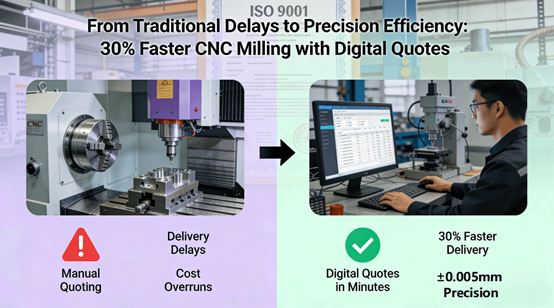
The medical device industry operates under a regime of stringent regulatory oversight and uncompromising quality demands. Traditional manufacturing methods often struggle with low production efficiency and high defect rates, which can compromise device reliability and patient safety. The core issue lies in the limitations of conventional CNC machining, which frequently lacks the customization and precision control necessary to meet the complex geometries and rigorous biocompatibility standards of medical devices, leading to cost overruns and project delays.
This article explores a solution: the integration of specialized aluminum CNC machining service, combined with advanced precision manufacturing services, to create an efficient, customizable production workflow that guarantees adherence to all quality assurance standards. The following sections will provide a detailed analysis of key strategies to help manufacturers optimize their production processes.
How Does Aluminum CNC Machining Service Meet the High-Precision Demands of Medical Devices?
Medical devices require micron-level precision to ensure proper function and safety, from the intricate components of surgical robots to the custom-fit elements of implantable devices. International standards like ISO 13485 set forth a framework for quality management that mandates traceability and consistency, placing immense importance on the manufacturing process.
The Imperative of Medical-Grade Precision
The transition from a digital design to a physical part used in a human body cannot tolerate error. Precision Manufacturing Services are foundational to this process, embedding compliance into every step. These services ensure that every batch of components, from prototype to production, adheres to predefined specifications, facilitating smoother regulatory approval and market entry.
Advanced Technology for Exceptional Tolerances
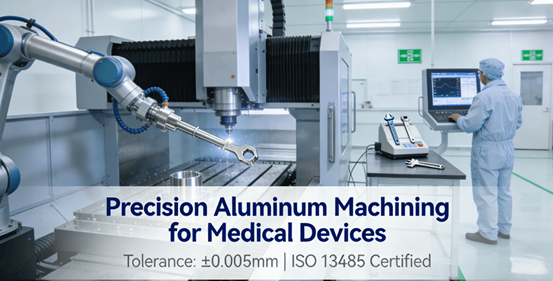
Meeting these stringent requirements is achieved through advanced technology. Modern five-axis CNC machining centers are pivotal for precision aluminum machining. Unlike simpler three-axis machines, five-axis technology allows the cutting tool to approach the workpiece from nearly any angle in a single setup. This capability is crucial for achieving complex geometries and maintaining tolerances as tight as ±0.005mm, effectively eliminating the errors associated with multiple re-fixturing operations.
- Complex Geometry and Single-Setup Machining:
This approach is ideal for components with deep cavities, complex contours, or undercuts, which are common in medical devices like custom surgical guides.
Enhanced Surface Finish and Accuracy:
By maintaining optimal tool-to-part orientation, five-axis machining also produces superior surface finishes, reducing the need for secondary operations and potential contamination points.
Case in Point: Surgical Instrumentation
Consider the production of a bespoke surgical tool. The device must be lightweight, ergonomic, and machined to exact specifications to ensure a surgeon’s control is perfectly translated. Through precision aluminum machining, manufacturers can produce these tools from high-strength aluminum alloys, achieving the necessary strength-to-weight ratio and complex features with the required accuracy. This level of precision, verified by coordinate measuring machines (CMM), ensures the device performs as intended in critical situations.
Why Are Aluminum Parts More Cost-Effective in Medical Device Prototyping?
In medical device development, speed and cost-effectiveness are paramount. The combination of Rapid Prototyping Technology and the use of aluminum parts offers a significant advantage. Aluminum alloys are favored for their excellent machinability, light weight, and good corrosion resistance. Compared to metals like stainless steel or titanium, aluminum is less expensive and faster to machine, allowing for more iterative cycles within a constrained budget.
A proficient CNC aluminum parts service leverages these material properties to accelerate development. By utilizing aluminum for functional prototypes, engineers can test form, fit, and function early in the design process. This approach can reduce development time by up to 20%, allowing teams to identify and rectify design flaws before committing to expensive production tooling. This agile methodology aligns with the need for accelerated innovation in the medical field, as highlighted by trends observed by institutions like the National Institutes of Health (NIH). The cost savings are not merely in the per-part price but in the overall reduction of project risk and time-to-market.
How to Ensure the Safety of CNC Medical Devices Through Quality Assurance Standards?
For CNC Medical Devices, safety is a system, not an accident. It is engineered through rigorous Quality Assurance Standards implemented by a qualified custom aluminum parts manufacturer. Certifications like ISO 9001 and the more demanding AS9100D (often adopted by high-end medical manufacturers) provide a framework for a robust Quality Management System (QMS).
This system ensures full traceability, from raw material certification to final inspection. For a medical device component, this means every part can be traced back to its specific material batch, machining parameters, and inspection reports. Production in a controlled, clean environment prevents contaminants, which is critical for parts requiring biocompatibility. For instance, a housing for a respiratory device must not only be dimensionally accurate but also free of particulates and able to withstand repeated sterilization. Adherence to these standards minimizes risk and builds trust with medical device OEMs, providing undeniable evidence of safety and compliance for end-users.
How Does an Aluminum CNC Machining Quote Impact the Total Cost of a Medical Device Project?
Understanding an aluminum CNC machining quote is the first step in effective project budgeting. The total cost is influenced by several factors, and a strategic partnership with a CNC machining parts supplier can lead to significant optimizations.
Deconstructing the Quotation
A detailed quote is based on part geometry (complexity, wall thickness), material selection (e.g., 6061-T6 vs. 7075), required tolerances, surface finishes (e.g., anodizing), and order volume. A design optimized for manufacturability (DFM) can dramatically reduce machining time and cost.
Strategic Volume and Partnership
Volume plays a critical role in cost management. For prototyping and low-volume production, CNC machining offers unparalleled flexibility without the high cost of molds.
- The Economics of Low-Volume Production:
While the unit price is higher than mass production methods, it avoids large upfront investments. Strategic planning can lead to a 35% reduction in initial costs compared to injection molding. - The Supplier as a Collaborative Partner:
An experienced supplier provides valuable DFM feedback, suggesting design tweaks that save material and machining time without compromising function, thereby controlling costs at the source.
The Total Cost of Ownership Perspective
Therefore, evaluating a quote for CNC machining services should extend beyond the unit price. A slightly higher quote from a supplier that offers exceptional quality, reliable lead times, comprehensive documentation, and expert DFM support can result in a lower total cost of ownership by avoiding rework, preventing project delays, and ensuring regulatory compliance.
Why is Localized Aluminum Fabrication Service Suitable for Emergency Medical Device Production?
The COVID-19 pandemic highlighted the critical importance of resilient supply chains. The search for “aluminum fabrication near me” became a strategic necessity for producing emergency equipment like ventilator components and test kit housings. Localized precision aluminum machining services offer distinct advantages in such scenarios.
The primary benefit is the drastic reduction in logistics time and risk. Sending a design file to a local supplier can lead to production starting within hours and parts delivered in days, a timeline impossible with overseas shipping. This proximity also allows for better communication and rapid on-site confirmations, accelerating problem-solving. For medical device manufacturers, establishing relationships with local suppliers is not just a cost-saving tactic but a crucial business continuity plan that ensures the ability to respond swiftly to urgent clinical needs.
Conclusion
In summary, specialized aluminum CNC machining services provide medical device manufacturers with a sustainable solution through high precision, controlled costs, and localized responsiveness. This approach is perfectly aligned with the industry’s trend towards more personalized, rapidly iterated, and highly reliable medical technologies.
To optimize your next medical device project, from prototype to production, consider partnering with an expert supplier for a customized quotation and comprehensive manufacturing solution.
Author Biography
This article was authored by the manufacturing experts at JS Precision, a company with over 20 years of experience specializing in high-precision aluminum CNC machining services. It is dedicated to advancing the medical device industry through innovative manufacturing technologies and an unwavering commitment to quality.
FAQ Section
Q1: Which medical devices are best suited for aluminum CNC machining services?
A1: These services are ideal for surgical instruments, non-implantable components, diagnostic equipment housings, and robotic surgery parts, where aluminum’s biocompatibility, light weight, and high-precision machining ensure safety and performance.
Q2: How can I get a fast aluminum CNC machining quote?
A2: Most suppliers offer online quoting platforms. Uploading your 3D CAD file (e.g., STEP, IGES) typically generates an instant or within-24-hour quote based on automated analysis of geometry, material, and quantity.
Q3: What are the main advantages of aluminum parts in medical devices?
A3: Key advantages include excellent strength-to-weight ratio, good corrosion resistance, ease of sterilization, and the ability to be machined into complex, high-precision geometries required for advanced medical applications.
Q4: How do Quality Assurance standards impact CNC medical device production?
A4: Standards like ISO 13485 mandate a certified Quality Management System, ensuring full traceability, process control, and documentation. This is non-negotiable for patient safety, regulatory approval, and market access.
Q5: Can local aluminum manufacturing services shorten delivery times?
A5: Yes, significantly. Local sourcing eliminates international shipping delays and complex logistics, enabling rapid production starts and faster delivery, which is critical for prototyping and emergency production runs.
Keep an eye for more latest news & updates on Aiotechnical!